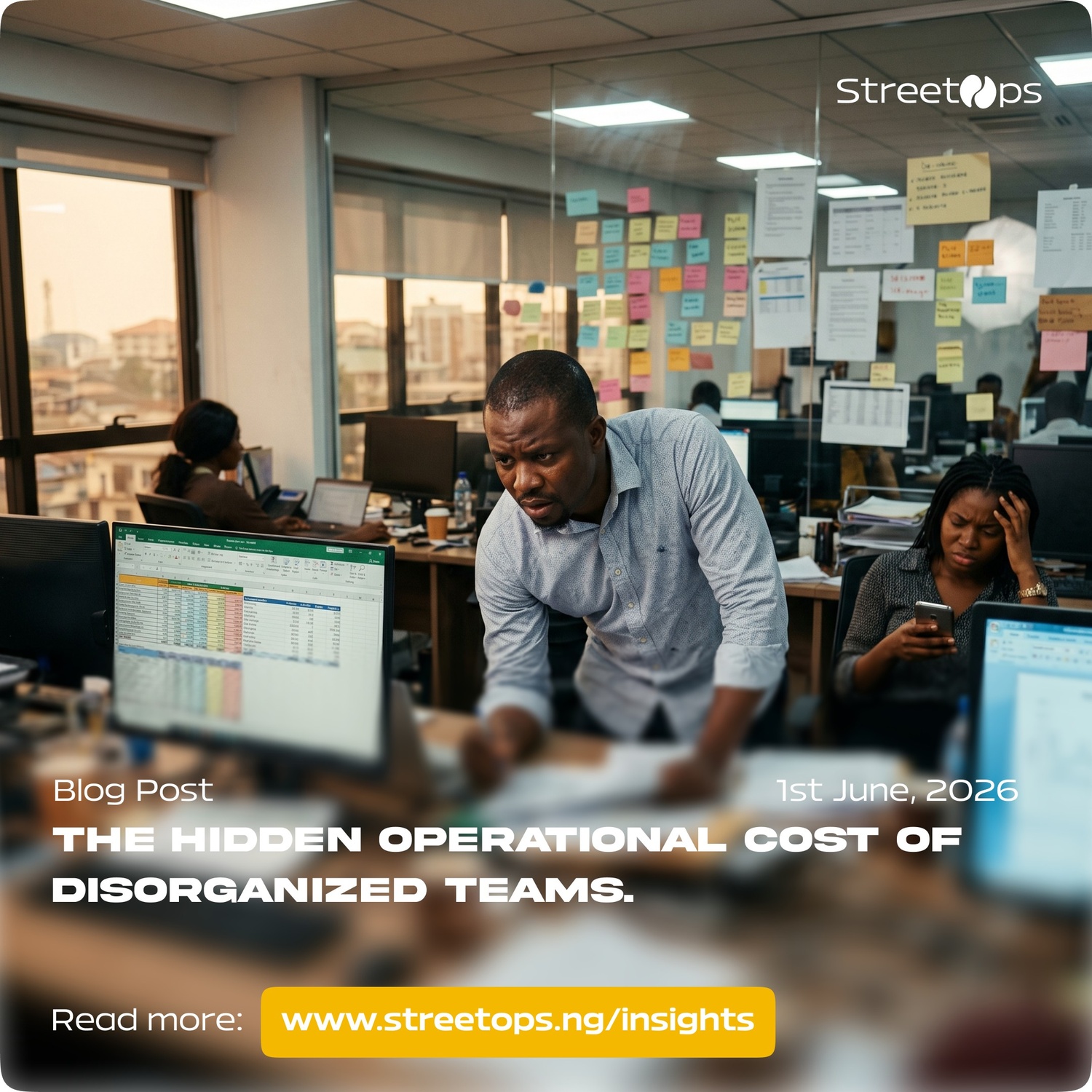
Disorganization rarely shows up on a P&L line. We look at where it actually costs organizations the most.
The Hidden Operational Cost of Disorganized Teams
There is a version of this problem that every founder and team leader recognises immediately. A task that should take three days stretches into three weeks. A deliverable that needed one person ends up touching six. A decision that could have been made on Tuesday is still being discussed on Friday. The work eventually gets done, but the path it took to get there cost far more than anyone stopped to calculate.
Disorganization in teams is rarely dramatic. It does not announce itself. It accumulates quietly, in the small frictions, the unclear ownership, the misaligned priorities, and the absence of systems that make the right way of working the default. And because each individual instance feels manageable, the total cost almost never gets properly accounted for.
From an organisational behaviour lens, that cost runs much deeper than most leaders realise, and it operates across several dimensions simultaneously.
The Operational Cost
The most visible cost is time, and time inside a business is salary. Research consistently shows that disorganized employees cost organisations an average of $3,800 in lost productivity per person annually, and that number compounds across a team. When a task that requires less than a week gets dragged across two months because ownership is unclear, priorities keep shifting, and nobody is held inside a system that creates momentum, the salary clock runs the entire time. The work is being paid for twice, once for the time it should have taken, and again for the time it actually took.
Beyond salary, disorganization creates what behavioural economists call decision fatigue at the team level. When people are constantly navigating unclear processes, resolving ambiguity that should have been designed out, and switching contexts because there is no reliable rhythm to the work, cognitive resources get spent on coordination rather than contribution. The team is busy but the output does not reflect it.
The Emotional Cost
There is a behavioural consequence to working inside a disorganized environment that rarely gets discussed in financial terms but has a direct financial impact. When people consistently operate without clear systems, without the satisfaction of completing things cleanly and moving forward, they begin to disengage. Not dramatically, but gradually. The effort they channel into work reduces incrementally as the environment trains them that effort and outcome are not reliably connected here.
Gallup estimates that disengaged employees cost the global economy $8.8 trillion annually in lost productivity, and while that figure operates at a macro level, the mechanism behind it is micro. It is built one frustrated employee at a time, inside one disorganized team at a time, in one environment that was never properly designed. The emotional fatigue of working in chaos is not a soft concern. It is a productivity tax that gets paid every single day.
The Cultural Cost
This is where the organisational behaviour lens becomes most important, and most uncomfortable. Schein's model of culture reminds us that what people experience consistently enough becomes assumption. When a team operates inside disorganization for long enough, the disorganization stops being a problem they are trying to solve and becomes the norm they expect. Unclear ownership starts to feel normal. Missed timelines stop producing urgency. The bar for what good execution looks like quietly lowers, and that lowered bar gets embedded into the shared assumptions of the group.
Once that happens, it is extraordinarily difficult to change, because you are no longer dealing with a process problem. You are dealing with a cultural one. The assumption that this is just how things work here is now running underneath everything, invisible to most of the people inside it, and resistant to surface level interventions like new project management tools or a strongly worded all-hands.
The Recruitment Cost
Disorganized environments produce turnover, and turnover is expensive in ways that most organisations significantly underestimate. Gallup research shows that replacing a single employee can cost between half and two times their annual salary. For a manager, that is a significant sum per departure, and disorganized teams tend to see above average departure rates because talented people, specifically the ones with options, leave environments where they cannot do their best work
About 73% of hiring managers report that employee turnover places a heavy burden on the remaining employees, which means every departure does not just cost the recruitment fee. It costs the focus, energy, and morale of everyone left behind who now has to absorb the gap. The recruitment cycle then begins again, and a new person gets onboarded into the same disorganized environment that drove the previous person out, which means the cycle simply repeats.
The Fix Is Structural
The reason most attempts to solve disorganization fail is that they address the symptoms rather than the underlying behavioural environment. A new tool does not fix unclear ownership. A team meeting does not fix misaligned priorities. A motivational session does not fix the cultural assumption that this is just how things work here.
What actually fixes it is designing the environment so that organized, accountable, high execution behaviour becomes the path of least resistance. That means building the systems, rhythms, and behavioural feedback loops that make the right way of working feel natural rather than effortful, and doing that work at the level where culture actually lives, in the daily operating conditions of the team rather than in the values on the wall.
That is the work we do at StreetOps, and the organisations that take it seriously stop paying the hidden tax that disorganization quietly charges every single month.