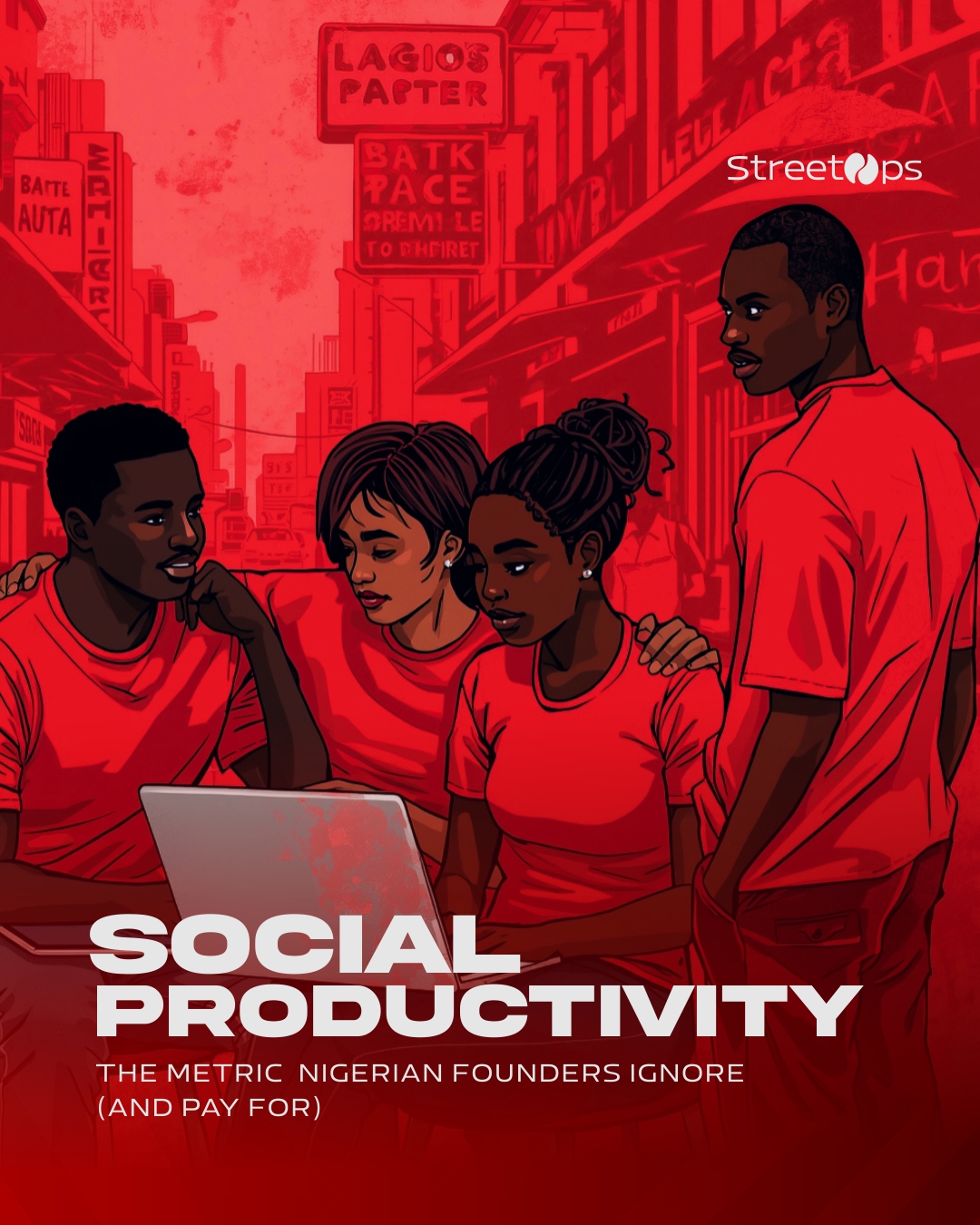
Founders track revenue and burn rate religiously, but rarely how connected their team actually is. We look at the metric that predicts the rest.
You track revenue. You track burn rate. You track customer acquisition cost, conversion rates, and monthly active users. But there's one metric most Nigerian founders never measure, and it's costing them more than all the others combined. It's not on your dashboard. It's not in your investor deck. And the moment you ignore it, everything else starts falling apart.
Here's a scenario you've probably lived: You hire someone talented. Their CV is impressive. The interview goes well. They accept your offer. Everyone's excited. Three months later, projects are delayed. Communication is messy. Meetings multiply, but nothing moves forward. The person who seemed brilliant in the interview is now just there. You blame the hire. "Maybe they weren't that good after all." But here's what's actually happening: your team isn't unproductive. They're socially disconnected.
Most businesses are built on a flawed assumption: if everyone does their job well individually, the team will perform well collectively. It's like putting Messi, Ronaldo, and Neymar on a football pitch and expecting to win without them ever passing the ball to each other. Talent without connection is chaos. You can have the smartest engineers, the sharpest salespeople, the most creative designers, but if they're not actually working together, you're just paying expensive people to work in parallel, not in sync. And working in parallel is dramatically more expensive than working together.
When teams are socially disconnected, the pattern is predictable. Someone quits after 90 days. You spend money recruiting again. The team gets disrupted. Projects get delayed. Morale drops. You hire someone new. The cycle repeats. But the cost isn't just financial. It's operational. Tasks that should take one conversation take five emails and a meeting. Decisions that should happen in real-time get stuck in "let me check with the team." Projects that should flow smoothly hit constant friction because people don't know how to work with each other. You can't scale that. You can't grow a business where collaboration is accidental.
Here's where most founders focus their energy: hiring "rock stars," setting aggressive KPIs, tracking individual output, and measuring productivity per person. It makes sense on the surface. Hire great people, set clear targets, measure results. But individuals don't achieve objectives. Teams achieve objectives. And if your team members don't know how to collaborate, communicate, and coordinate with each other, your objectives don't get met, regardless of how talented each individual is.
Social productivity isn't about making people work faster. It's about making them work together better. It's the ability of a team to execute collectively. It's measured by how well people communicate across functions, how quickly decisions actually get made and implemented, how naturally collaboration happens without constant management intervention, and how long people stay and build institutional knowledge. Individual productivity tells you if someone can do their job. Social productivity tells you if your team can achieve your business goals. And here's the uncomfortable truth: you can have high individual productivity and low social productivity at the same time. You can have everyone "busy" while nothing actually moves forward.
In Nigeria, the cost of getting this wrong is higher. Talent is expensive to replace. Good people have options. And when someone leaves, they don't just take their skills; they take the context they built, the relationships they formed, and the momentum they created. You're not just losing an employee. You're losing the social infrastructure they were part of. And every time you bring someone new in without intentionally building their connection to the team, you're gambling with expensive odds.
Most Nigerian founders follow a familiar pattern. They spend three months finding the right person, celebrate when they accept the offer, assume the work is done, watch them struggle to integrate, watch them quit or underperform, blame "bad luck" or "poor culture fit," and then repeat the entire process. But culture fit isn't something someone either has or doesn't have. It's something that's built, or not built, in the first few weeks. Social productivity isn't something that happens naturally just because you hired good people. It's something you engineer.
Building social productivity means treating collaboration as infrastructure, not coincidence. It means designing how people actually meet and connect instead of hoping they "figure it out." It means creating systems where information flows naturally instead of getting stuck in silos. It means building teams where people know how to work together, not just what to work on. It means measuring engagement and connection, not just output and completion. This isn't about team bonding exercises or casual Fridays. It's about the operational mechanics of how your team actually functions when they need to get work done together.
Nigerian founders are brilliant at solving hard problems. They build in difficult markets. They figure out distribution. They navigate regulation. But most still treat team collaboration as something soft, secondary, or automatic. It's not. Social productivity is an operational metric, not a cultural nice-to-have. And the businesses that recognize this, that measure it, invest in it, and build it intentionally, are the ones that don't just survive. They scale.
Because at the end of the day, your business isn't what one person can do. It's what your team can do together. And if they can't do it together, everything else you're measuring doesn't matter.
StreetOps builds social productivity infrastructure for Nigerian businesses through behavioral technology. We believe in culture transfer, not information transfer.