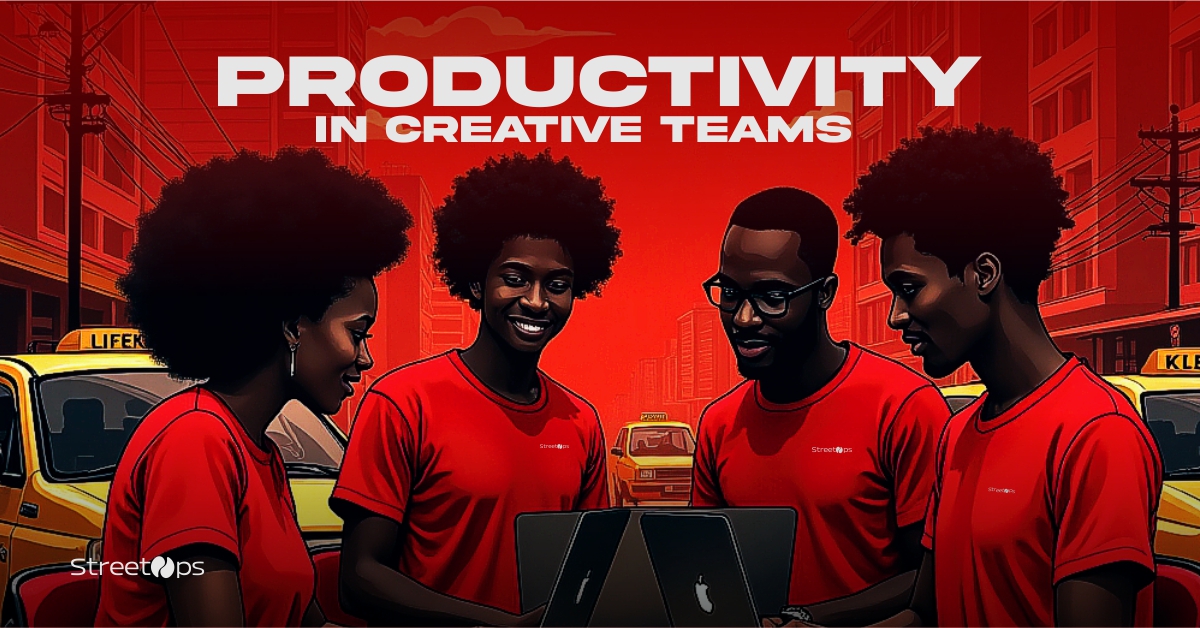
Standard management playbooks assume predictable schedules and clear hierarchies. We look at why creative teams need a different one.
The director is three hours late to the production meeting. The cinematographer hasn't responded to emails in two days but just posted a brilliant concept piece on Instagram at 3am. The production designer insists they need to "feel the space" before committing to a timeline.
Welcome to managing creative teams, where every management principle you've learned suddenly stops working.
The psychology of creative professionals operates on fundamentally different principles than traditional knowledge workers. Trying to force creatives into conventional team structures is like trying to make water flow uphill. The question isn't whether creatives need structure. They do. The question is what kind of structure actually works for minds that live half in reality and half in imagination.
Most creative teams in Nigeria operate in extremes. Either complete chaos (everyone doing their own thing, timelines as suggestions) or rigid corporate structure that slowly suffocates creativity. Film sets descend into expensive disorder. Music studios become battlegrounds of conflicting visions. The real problem isn't that creatives are disorganized. It's that we're trying to organize them using frameworks built for linear thinking when creative work is fundamentally non-linear.
Creative work happens in the mind first. A cinematographer might spend three days apparently doing nothing, then produce a shot list in four hours that transforms the entire project. This isn't dysfunction. This is how creative cognition works. The challenge is that while the creative process is non-linear, production timelines are not. Budgets are real. Deadlines exist. This tension is where most creative teams break down.
You can't timeblock insight. You can't Gantt chart inspiration. And when you try, you don't get organized creativity. You get organized mediocrity.
Here's the key insight: creatives don't need less structure than other professionals. They need a different structure. Structure that acknowledges how their minds actually work.
Start with how information flows. Creatives process information visually, experientially, contextually. A production designer doesn't need a written brief as much as they need to walk through the location. A musician doesn't need a detailed document as much as they need to hear reference tracks and talk about feeling. The information is the same, but the delivery mechanism matters enormously.
This is why you can't just hand a film crew a manual and expect them to absorb the project vision. They need to experience it. When crew members show up to set without really understanding the director's vision, the result is expensive chaos. Camera department making decisions that contradict production design. Sound recording in ways that limit editing options. Everyone technically doing their job, but the collective output falling short.
Then there's collaboration patterns. Creatives work in intense bursts followed by apparent downtime. They might seem disengaged for days, then suddenly need to collaborate intensely for hours. These aren't inconsistencies: they're phases of the creative process. The best creative teams develop "flexible synchronization." Not everyone working at the same pace simultaneously, but synchronized at the points where it matters.
And here's the critical part: creative teams actually have higher collaboration requirements than most other teams, not lower. A corporate team might coordinate through documentation. But a creative team needs genuine understanding of each other's work, shared vision, and the ability to build on each other's ideas in real-time. You can't make a great film if departments don't understand what each other is trying to achieve.
This is why the chaos on many Nigerian creative sets isn't about talent: it's about social infrastructure. When crew members meet for the first time on day one of production, they're expected to immediately function as a coordinated unit under pressure. That's not reasonable. That's organizational negligence. The result is expensive miscommunication, preventable mistakes, and creative output that falls short of what that talent was capable of producing.
What would it actually look like to build social productivity for creative teams? Creating intentional space before production starts for the team to actually become a team. Real work on understanding the project vision, how each role contributes, what each department needs from the others. Building the informal communication channels that allow problems to get solved quickly when pressure hits.
It means acknowledging that creatives process information differently. Less "read this document," more "let's walk through this together." Less formal hierarchies that suppress input, more psychological safety that encourages contribution. Less rigid scheduling, more milestone-based coordination.
It means measuring the right things. Not how many hours someone worked, but whether they're actually connected to the vision and collaborating effectively. Not output per individual, but creative cohesion across the team.
Nigerian creative industries are full of brilliant individual talent. What's often missing is the infrastructure that allows that talent to actually work together effectively. Film productions that could be masterpieces get diminished by coordination failures. Music that could be groundbreaking gets diluted by fragmented execution.
The opportunity isn't to make creatives more corporate. It's to build productivity systems that actually fit how creative work happens. Because at the end of the day, creative work is still work. And work still requires people to work together effectively. The difference is just that for creative teams, "working together effectively" looks different than it does for everyone else.
Social productivity for creative teams isn't about making artists more organized. It's about organizing the conditions under which artists can actually collaborate at their highest level.
StreetOps builds social productivity infrastructure for teams, including creative productions. We understand that different types of work requires different types of collaboration, and we design systems accordingly.